
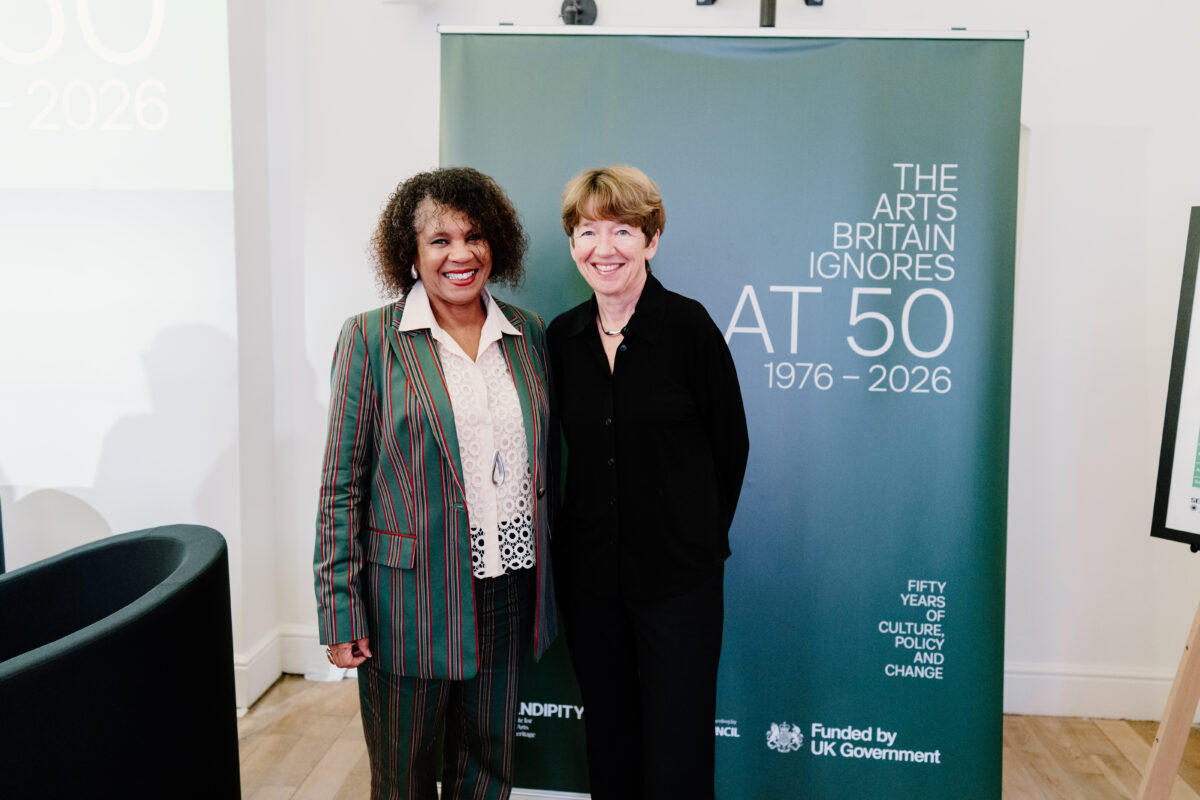
Diversity Arts Policy and Research Associate Dr Zozan Balci reflects on her recent participation in the The Arts Britain Ignores at 50 event.
Fifty years ago, cultural historian Naseem Khan published The Arts Britain Ignores, a landmark report that challenged Britain’s cultural establishment to recognise what was already happening beyond its field of vision. Khan documented a rich cultural landscape spanning Black visual arts, bhangra, Urdu poetry, carnival, dance and other practices flourishing within Britain’s minoritised communities. Her argument was that diversity was already there and the institutions responsible for defining, funding and legitimising British culture had failed to see it. Fifty years later, Serendipity Institute for Black Arts and Heritage brought artists, cultural leaders and policymakers together in Leicester to consider Khan’s legacy, accompanied by a new collection of essays and research asking how far the sector has really travelled.
The question remains strikingly contemporary, with clear resonance in Australia. Creative Australia’s Towards Equity 2 is currently undertaking its own stocktake of who participates in, leads and receives investment across Australia’s arts and cultural sector. The latest findings point to progress since 2021, but the very existence of this ongoing measurement reminds us that representation alone is not sufficient – it matters also who has authority, whose work becomes part of the cultural canon, whose stories are considered universal rather than specialist, and who is required to continually justify the value of their contribution.
These questions ran throughout the anniversary gathering. Speakers argued for Black and culturally diverse narratives to be embedded within cultural programming throughout the year, rather than activated principally through designated months or commemorative moments. They also asked us to examine the frameworks through which culture itself is organised. One example raised was the positioning of Egypt separately from Africa within museum traditions, a seemingly simple classification that opens much larger questions about who constructs cultural categories and what histories those categories reproduce. Just as importantly, the event surfaced the exhausting expectation placed on culturally diverse artists and organisations to repeatedly prove their contribution. Recognition, advocacy and the work of demonstrating value must also be carried collectively by funders, institutions and the sector as a whole.
Perhaps the most urgent message of the anniversary was the fragility of progress. Against a backdrop of resurgent racism, increasingly hostile rhetoric around immigration and sustained pressure on arts funding, David Bryan CBE cautioned against dismissing what we are seeing as simply another turn in a familiar cycle as it risks making regression feel inevitable. The task is instead to appreciate how far the sector has moved, and refuse to surrender any of that ground.